
A new paper published on optimal H ATP synthase expression in E coli

We recently published a new paper, https://febs.onlinelibrary.wiley.com/doi/10.1111/febs.16401. Below you find a short reflection on this paper.

Microbial behaviour has been shaped by evolution. Our understanding is that the best adapted genetic variants are outcompeting the others — which explains their frequency increase and their selection. These fit variants generate novel genetic variants, which perform even better, equally good or worse. So perhaps we can rationalise the behaviour of microbes from the viewpoint of fitness maximisation by natural selection? More specifically, maybe we can understand phenotypic adaptations, e.g. protein expression, of particular microorganisms as fitness-maximising adaptations? 

At least two problems are associated with this view. The first problem is that fitness of a genotype is related to the performance over a long period. Fitness may therefore not be measurable at one particular moment in time. Instead, we should take the evolutionary history into account — recreate it somehow in the lab—, but these conditions we do not know. So assessing the fitness of a microbe is perhaps not so straightforward and fundamentally impossible? A second problem is that the winning genotype may not be close to an optimal fitness, it was after all merely better than its competitors and not necessarily optimal. How then can we make sense of microbes in the light of fitness?

In a recent paper, we took a very simple, perhaps-ignorant approach. At the outset we realised that: i. long-term fitness over a particular period equals the time-averaged growth rate over that period and ii. growth rate depends on metabolic protein concentrations that are limited by biosynthetic constraints. One corollary of this is that expression of unneeded proteins should reduce the immediate growth rate and another is that an optimal, immediate-growth-rate maximising protein expression level exists for needed proteins. Both have been experimentally verified. 

However, this optimal expression level maximises the immediate growth rate, which is not necessarily a strategy for long-term fitness (average growth rate) maximisation — which is what truly matters in evolution. 

This was our simple idea: We assumed that Escherichia coli does not have a recollection of its precise environmental history and generally lives in unpredictable environments. Given this, it made sense to us that E. coli may strive for long-term fitness maximisation (average growth rate maximisation) by maximising its immediate growth rate by optimal expression of metabolic proteins. An implicit hypothesis was that biochemical regulation can optimise metabolic systems, for which we had obtained theoretical evidence already. Finally, we were aware of literature showing immediate-growth-rate-maximising expression of particular other proteins. What was not known is whether cells can do this robustly, so across a great many conditions — representing an unpredictable environment. 

To test this, we took a protein that is ubiquitously expressed and expensive for the cell to make: its membrane embedded FoF1 ATP-synthase, which makes ATP at the expense of the proton motive force, which is maintained by oxidative phosphorylation. This process is the only ATP synthesising step when ATP is not made via substrate-level phosphorylation in glycolysis. So during growth on gluconeogenic carbon sources. Since the growth rate on those carbon sources greatly varies, the ATP demand per unit time will too, and therefore the needed level of ATP-synthase may vary accordingly. We tested 28 different conditions and we found that in all cases the expression level of this vital protein lies within a few percent of the optimal level that maximises the immediate growth rate. So, an E. coli cell has a growth-rate-maximising expression level of its ATP synthase.

This work is intriguing and puzzling at the same time. In biology, we rarely know the objective of molecular control systems. That objective may be ultimately related to the performance of the organism, but how it relates to that is often not understood. Here we found such an objective: expression regulation of ATP-synthase has growth-rate maximisation as its objective. How it achieves this is not understood, but the regulation of other systems points to possible mechanisms. What’s puzzling is how our results can be reconciled with seemingly conflicting data indicating that other metabolic proteins may be over-expressed, such as enzymes in lower glycolysis and the overcapacity of the ribosome? Is this occurring because cells can then faster transit to new conditions? Why is this not the case for ATP-synthase, which is likely also needed during transitions? Or are those cases not really cases of overexpression, but is having a low v/Vmax ratio actually the optimal behaviour required for immediate growth rate maximisation? On all of these questions, the field does not yet have satisfactory answers. 

Before this study, one could have argue that the fitness-maximisation question cannot really by answered because we do not know the evolutionary history, but this study (and others) suggests that perhaps many regulatory aspects of bacteria boil down to immediate fitness maximisation, because they live in such unpredictable environments. Perhaps their best bet on a high long-term fitness is to bet on immediate fast growth.
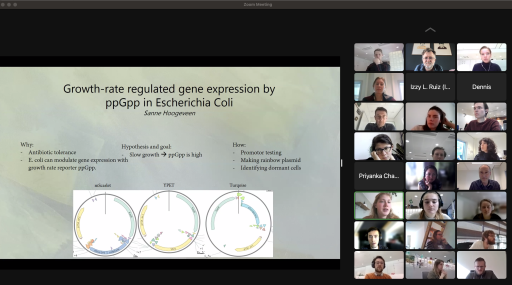
Internship students symposium 2022

On March 11th we had a very exciting Internship Students Symposium!

A total of 23 students from the MCB department presented the work that their are going to do in the lab in front of their peers and the staff. About 50 people joined the symposium and we had a very lively scientific discussion after each short talk.

All the students made a terrific job in preparing their pitches! We hope that this will help everyone to know what their colleagues are doing in the lab and to establish fruitful collaborations in the coming months.

Good luck with your internship… We are looking forward to see your results!

Eunice won the LABIP poster award for excellent research with industrial relevance

At the13th international symposium on lactic acid bacteria Eunice van Pelt – KleinJan, PhD student in Bas Teusink’s group, won the LABIP poster award for excellent research with industrial relevance. The poster “Proteome constraints shape Lactococcus lactis’ metabolic behaviour” shows that we can understand the changes and choices in energy metabolism that Lactococcus lactis (needed a.o. for Gouda cheese) makes, based on the protein costs and energy yield of the metabolic strategies. As such we could rationalize why certain amino acids are taken up in excess or not at all. The work helps rationalizing how conditions may affect the fermentative behaviour of lactic acid bacteria.

‘Swim or grow? Reserach article with Remco.

Research article with Remco: Different Resource Allocation in a Bacillus subtilis Population Displaying Bimodal Motility.

Collaboration between TNO, UvA and VU about resource allocation in Bacillus subtilis leads to new study published in Journal of Bacteriology this month (June 2021).

https://jb.asm.org/content/203/12/e00037-21

Publication by Chrats: High biodiversity in a benzene-degrading nitrate-reducing culture is sustained by a few primary consumers.

A key question in microbial ecology is what the driving forces behind the persistence of large biodiversity in natural environments are. We studied a microbial community with more than 100 different types of species which evolved in a 15-years old bioreactor with benzene as the main carbon and energy source and nitrate as the electron acceptor. Using genome-centric metagenomics plus metatranscriptomics, we demonstrate that most of the community members likely feed on metabolic left-overs or on necromass while only a few of them, from families Rhodocyclaceae and Peptococcaceae, are candidates to degrade benzene. We verify with an additional succession experiment using metabolomics and metabarcoding that these few community members are the actual drivers of benzene degradation. As such, we hypothesize that high species richness is maintained and the complexity of a natural com- munity is stabilized in a controlled environment by the interdependencies between the few benzene degraders and the rest of the community members, ultimately resulting in a food web with different trophic levels.

https://www.nature.com/articles/s42003-021-01948-y.pdf

Article published by Paul : Effects of DNA preservation solution and DNA extraction methods on microbial community profiling of soil

Abstract

Microbial community profiling using high-throughput sequencing relies in part on the preservation of the DNA and the effectiveness of the DNA extraction method. This study aimed at understanding to what extent these parameters affect the profiling. We obtained samples treated with and without a preservation solution. Also, we compared DNA extraction kits from Qiagen and Zymo-Research. The types of samples were defined strains, both as single species and mixtures, as well as undefined indigenous microbial communities from soil. We show that the use of a preservation solution resulted in substantial changes in the 16S rRNA gene profiles either due to an overrepresentation of Gram-positive bacteria or to an underrepresentation of Gram-negative bacteria. In addition, 16S rRNA gene profiles were substantially different depending on the type of kit that was used for extraction. The kit from Zymo extracted DNA from different types of bacteria in roughly equal amounts. In contrast, the kit from Qiagen preferentially extracted DNA from Gram-negative bacteria while DNA from Gram-positive bacteria was extracted less effectively. These differences in kit performance strongly influenced the interpretation of our microbial ecology studies.

https://link.springer.com/article/10.1007/s12223-021-00866-0

Nature review article by Evelina : Intracellular mRNA transport and localized translation.

Abstract

Fine-tuning cellular physiology in response to intracellular and environmental cues requires precise temporal and spatial control of gene expression. High-resolution imaging technologies to detect mRNAs and their translation state have revealed that all living organisms localize mRNAs in subcellular compartments and create translation hotspots, enabling cells to tune gene expression locally. Therefore, mRNA localization is a conserved and integral part of gene expression regulation from prokaryotic to eukaryotic cells. In this Review, we discuss the mechanisms of mRNA transport and local mRNA translation across the kingdoms of life and at organellar, subcellular and multicellular resolution. We also discuss the properties of messenger ribonucleoprotein and higher order RNA granules and how they may influence mRNA transport and local protein synthesis. Finally, we summarize the technological developments that allow us to study mRNA localization and local translation through the simultaneous detection of mRNAs and proteins in single cells, mRNA and nascent protein single-molecule imaging, and bulk RNA and protein detection methods.

https://www.nature.com/articles/s41580-021-00356-8

Welkom Julius

Julius Battjes will work on the ZeroYeast project together with Chr Hansen, and make a proteome-constrained model of Pichia kluyveri with the aim to transfer knowledge from S cerevisiae to another industrial yeast.