
We reviewed more than a decade of research on the search for principles of microbial physiology

When Bas Teusink and Douwe Molenaar came to the VU University, about a decade ago, they had just published a thought-provoking paper on how microbial physiology can result from optimal allocation of biosynthetic resources, such as ribosomes, RNA polymerases, amino acids, energy, etc., in order to maximise growth rate (https://doi.org/10.1038/msb.2009.82). Roughly at the same time, a paper from Terry Hwa’s lab was published providing experimental evidence for the potential of thinking in terms of allocation of limited biosynthetic resources — regardless of any optimality assumption (https://science.sciencemag.org/content/330/6007/1099). Some of those ideas can be traced back to the ideas of Kjeldgaard, Schaechter and Maaløe several decades ago (e.g. O. Maaløe, An analysis of bacterial growth, Developmental Biology Supplement, 3, 33-58, 1969). Many of developments of the last decade have now been reviewed by us in FEMS Microbiology Reviews (https://doi.org/10.1093/femsre/fuaa034).

What has become clear in the last decade is that the assumption of maximal (per capita of specific) growth rate is a very powerful one to understand the behaviour of (model) microorganisms, such as Escherichia coli and Saccharomyces cerevisiae. Why they express certain metabolic pathways, to which degree they tune expression of proteins, what the fitness effects are of unneeded protein expression, and what limits growth can all be predicted in the current theoretical framework, which matches experimental data remarkably well.

This review also indicates the great potential of theory in microbiology and the likely universality of the underlying causes of many metabolic behaviours.

We hope that you enjoy reading the review, we certainly had a lot of fun writing it, and performing some of the research mentioned in it.

SBML Level 3: the standard for encoding models of biological processes

Brett and Bas are co-authors on a new paper in Molecular Systems Biology describing the latest developments in model encoding in systems biology. Bas enthusiastically supports the use of standards in systems biology while Brett has been active in the SBML field for 15 years as a community member, specification writer, package coordinator (FBC), libSBML developer, editor and SBML team member.

This paper provides an overview of the modelling frameworks, tools and facilities that are central to the SBML community.

SBML Level 3 overview
SBML Level 3

“Systems biology has experienced dramatic growth in the number, size, and complexity of computational models. To reproduce simulation results and reuse models, researchers must exchange unambiguous model descriptions. We review the latest edition of the Systems Biology Markup Language (SBML), a format designed for this purpose.

A community of modelers and software authors developed SBML Level 3 over the past decade. Its modular form consists of a core suited to representing reaction‐based models and packages that extend the core with features suited to other model types including constraint‐based models, reaction‐diffusion models, logical network models, and rule‐based models.

The format leverages two decades of SBML and a rich software ecosystem that transformed how systems biologists build and interact with models. “

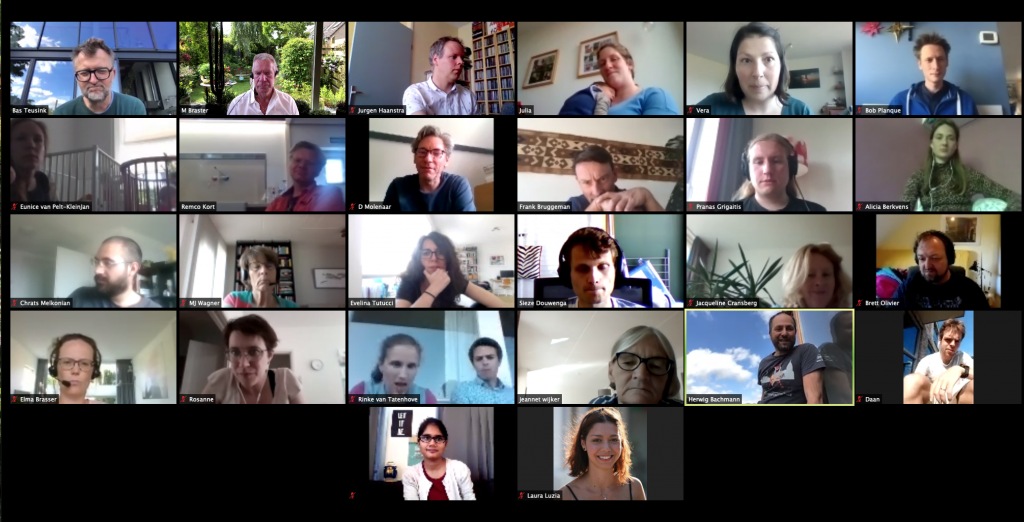
Zoom Celebration

Zoom Celebration at SysBioLab. 

Zoom screen shot

Rinke has a tenure track position in Delft, Bas got a new project granted, and Frank published a massive paper in Current Biology together with Johan, all on the same (Mon)day.

With such good news it is time to celebrate! Lets open the bottle (that will be delivered to you today) together.

Enjoy and stay healthy! Rinke, Bas and Frank

On behalf of all of us, Congratulations and thank you for the surprise.

A special thanks goes to the delivery boy! Thanks for bringing it to us.

Paper by Niclas, Johan and Frank

Biphasic Cell-Size and Growth-Rate

Homeostasis by Single Bacillus subtilis Cells

Abstract

The growth rate of single bacterial cells is continuously disturbed by random fluctuations in biosynthesis rates and by deterministic cell-cycle events, such as division, genome duplication, and septum formation. It is not understood whether, and how, bacteria reject these growth-rate disturbances. Here, we quantified growth and constitutive protein expression dynamics of single Bacillus subtilis cells as a function of cell-cycle progression. We found that, even though growth at the population level is exponential, close inspection of the cell cycle of thousands of single Bacillus subtilis cells reveals systematic deviations from exponential growth. Newborn cells display varying growth rates that depend on their size. When they divide, growth-rate variation has decreased, and growth rates have become birth size independent. Thus, cells indeed compensate for growth-rate disturbances and achieve growth-rate homeostasis. Protein synthesis and growth of single cells displayed correlated, biphasic dynamics from cell birth to division. During a first phase of variable duration, the absolute rates were approximately constant and cells behaved as sizers. In the second phase, rates increased, and growth behavior exhibited characteristics of a timer strategy. These findings demonstrate that, just like size homeostasis, growth-rate homeostasis is an inherent property of single cells that is achieved by cell-cycle-dependent rate adjustments of biosynthesis and growth.

Read the whole paper

What makes steady-state population growth possible? – a new paper by us in Current Biology

Growing cells in constant conditions at a fixed exponential growth rate in a shake flask — balanced growth — is arguably the most basic experiment in microbiology. We are so used to it that we sometimes forget to realise that this is not at all so obvious.

Not only the average growth rate remains fixed, but also the average cell size at birth and division. Either this emerges for free, and no active homeostatic mechanisms are required, or balanced growth requires evolved regulatory mechanisms. Analysis of experimental data, using a deceptively, simple theory, by Susan et al. [1], indicates that active homeostatic mechanisms are at work during steady-state growth and that without those balanced growth would be possible.

That cell-size homeostasis mechanisms exist and are required for balanced growth was already known — mostly from work by Suckjoon Jun’s lab. But what about growth-rate homeostasis? Do active mechanisms exist that maintain a constant average (and variance) of single-cell growth rate? Here we show that that is indeed the case for Bacillus subtilis.

We also found that its cell cycle is composed out of two phases. A first one, during which cells with variations in birth size correct size differences — they behave as “sizers” — and a second one during which cells behave as “timers” — they grow for a nearly fixed duration.

Our most surprising, and novel, finding was that cells experience a great disturbance of growth rate at division, with smaller cells outgrowing larger ones, while at division that growth rate variation has largely disappeared and growth rate became independent of cell size at birth.

So, also a growth-rate homeostasis mechanism is at work in Bacillus subtilis— like it is for cell size. How it works, we are currently figuring out.

You can find our paper here: https://www.cell.com/current-biology/fulltext/S0960-9822(20)30544-3.

References:

  1. Susman, L., Kohram, M., Vashistha, H., Nechleba, J.T., Salman, H., andBrenner, N. (2018). Individuality and slow dynamics in bacterial growth ho-meostasis. Proc. Natl. Acad. Sci. USA 115, E5679–E5687.

An integrative view on how metabolic fluxes sustain growth of liver cancer cells

Jurgen Haanstra and Bas Teusink collaborated with several research groups on interdisciplinary research combining wetlab experiments with computational models.

Haanstra and Teusink collaborated with research groups in Gothenburg (Sweden), Groningen and Heidelberg (Germany). Their work on a quantitative analysis of amino acid metabolism in liver cancer, with Jurgen as co-first author, was just published in PNAS.

Metabolic changes are a well-known hallmark of cancer, but an integrative view on how metabolic fluxes sustain (high) growth rates is often lacking. In this study the authors used a combination of experimental measurements and computational modelling to understand metabolism of HepG2 liver cancer cells during in vitro growth at different glucose levels.  The measured fluxes of glucose, pyruvate, lactate and amino acids during growth were integrated with a genome-scale reconstruction of liver cancer metabolism to estimate the intracellular metabolic fluxes that should be operational to sustain this growth.

The analysis published in PNAS shows that many amino acids are consumed at rates exceeding the need for biomass formation. The intracellular fluxes indicate that a large part of the glutamine that is consumed is metabolised in the cytosol to support biosynthetic processes. A large part of the glutamate that results from these processes is excreted. This led to the hypothesis that inhibition of glutamate export would decrease growth and this was validated in an experiment where glutamate export was inhibited.

The work shows that genome-scale metabolic models constrained with measured fluxes can be used to estimate the effects of inhibitors of metabolic reactions.

Standardising the quality of genome scale models

Moritz Bieber, Christian Lieven (Biosustain, DTU), Brett Olivier and Bas Teusink (AIMMS, VU Amsterdam) and a worldwide community of scientists developed quality control tools for systems biology models in Nature Biotechnology

model quality control
Standardising model quality

Mathematical models are key tool to understand complex biological systems. In particular, constraint-based, genome scale, models (GSM’s) can relate the physiological property of a cells, such as growth and metabolism, to the chemical flows through the underlying metabolic reaction network encoded by the genes. However, each model can in itself contain thousands of components. Moreover there is a continuous increase in number of these models being produced, using various semi-automated methods. The question arises, how do you evaluate a models quality? Being able to answer this question is critical to a model’s reproducibility and reusability.

In a recent correspondence published in Nature Biotechnology Moritz Bieber, Christian Lieven (Biosustain, DTU) and a large, worldwide community of scientists including Brett Olivier and Bas Teusink (AIMMS, VU Amsterdam) set out to address this problem. The tool presented in this contribution, MEMOTE, leverages the advantages of the latest community developed model encoding standards (SBML FBC), and implements a pipeline containing a set of tests that evaluates a model’s annotation, basic functionality and conceptual integrity. Hopefully, this will lead to a more efficient (re)use of genome-scale models in research and biotechnology.

Herwig and Chrats gave a science talk in a bar

On the 11th of February Herwig and Chrats embraced the challenge of talking to a non-scientific audience in an event hosted by Pint of Science. In their enthusiastic talks they explained how microbial communities and particular species contribute to the process of cheese and wine making, and how do scientists achieve distinct final products by using different combinations of microbes. The atmosphere was casual and Herwig and Chrats were impressed by the originality of the questions they got! Besides their talks, there was a cheese and wine tasting activity very much appreciated by the audience that now knows better how to select their perfect cheese/wine. The event was a great success!

Fifteen different models of overflow metabolism convey a single message: overflow metabolism is caused by two growth-limiting constraints.

We recently published an article in which we reviewed the different approaches that describe a puzzling metabolic phenomenon called overflow metabolism: (https://doi.org/10.1007/s00018-019-03380-2).

Many different organisms secrete ‘overflow products’ in conditions where they grow and reproduce fast. For example, many yeasts produce ethanol, Escherichia coli produces acetate, and cancer cells produce lactate. This behaviour seems counter-intuitive because the production of overflow products is inefficient in terms of energy. The cells do not fully use the energy stored in their growth substrates at high growth rates, while they do fully use this energy at lower growth rates.

To study this phenomenon, many mathematical/computational models have been proposed, based on different biological fundaments and using different assumptions. However, since the models can all reproduce overflow metabolism, no final conclusion could be drawn about which model is closest to reality.

We therefore decided to analyse all constraint-based optimization approaches that describe overflow metabolism. Although these models appear very different: the approaches range from relatively simple flux balance analyses to self-fabricating metabolism and expression models, we could rewrite all of them in one standard form. We then looked for a common feature, for this could unveil the cause of overflow metabolism, and for differences, for these can be used to design experiments that test the different models and their assumptions.

We found that all models predict overflow metabolism when two growth-limiting constraints are hit, while the specific nature of the constraints differed between the models. This is in line with recent theory: (https://doi.org/10.1371/journal.pcbi.1006858). We concluded that finding the true cause of overflow metabolism in a specific organism thus amounts to proving which two constraints limit the growth of that organism. However, we did not find such decisive proofs for any constraint. Therefore, we decided to list all the proposed constraints, such that these can hopefully all be tested by specific perturbation experiments in the future.