Julia wins photo competition at the End-of-Summer drinks.

Although the weather still gives the idea that summer didn’t end yet, we had end-of-summer drinks last week. It was a nice get-together and many people joined for a drink and a chat.. The drinks were accompanied by a photo competition with 21 entries. During the drinks the photos were hanging on the wall for the participants to judge which photo stood out most and should win a prize. Ten pictures got at least one vote, but there was a clear winner: Julia’s picture of a duck in Leiden got 7 votes and made her the winner of our competition. She won a 500-piece puzzle of an image of of O|2. Congratulations!

After the voting, lively discussions arose on who had sent in which picture. As the pictures were a clear added value to the first-floor balcony, they were still there by the end of the week – and remained a talking point.

DAAN DE GROOT WINT NK IN SPIJKENISSE

7-10-2018

Het NK Duathlon werd vandaag een prooi voor Daan de Groot.

De Groot trok tijdens het fietsen de wedstrijd naar zich toe.

Bij de mannen ging Wesley Mols na het startschot er direct hard vandoor, om met een ruime marge aan het fietsen te kunnen beginnen. Achter hem maakte De Groot samen met Hellas-ploeggenoot en titelverdediger Yennick Wolthuizen tijdens het fietsen snel de gang naar voren terwijl Mols terugduikelde in het klassement. Eenmaal op het tegenwindse stuk nam De Groot afstand om in de tweede fietsronde nog meer marge op Wolthuizen te nemen. Met twee minuten voorsprong wisselde De Groot naar het lopen, en op het slotonderdeel hoefde hij niet meer om te kijken. Met een sterke slotrun wist Alexander Picard alsnog de derde plaats te bemachtigen.

Source: Transition; Triathlon & Run Bike Run

Two papers published by Sebastián

Two papers about genome-scale reconstruction and analysis were published by Sebastián Mendoza in March 20th and May 23th. These articles are entitled “Mapping the Physiological Response of Oenococcus oeni to Ethanol Stress Using an Extended Genome-Scale Metabolic Model” and “Traceability, reproducibility and wiki-exploration for “à-la-carte” reconstructions of genome-scale metabolic models“, respectively.

Both papers were submitted while Sebastián was working as a project engineer at the laboratory of Alejandro Maass (Mathomics, Center for Mathematical Modeling, Faculty of Mathematical and Physical Sciences, University of Chile) and now they have finally seen the light. Contreras et al., 2018 is the follow-up study of a previously published article (Mendoza et al., 2017) and was conducted in collaboration with the laboratory of Eduardo Agosín at the Department of Chemical and Bioprocess Engineering of the Pontifical Catholic University of Chile.

The first paper, which was published in the journal Frontiers of Microbiology, studies how different ethanol concentrations in the media affect the metabolism of Oenococcus oeni, the malolactic bacteria that performs the secondary fermentation during winemaking. Besides providing the first wine-like chemically defined media for this microorganism, this paper takes advantage of the previously reconstructed genome-scale metabolic model and shows the distribution of fluxes under different ethanol conditions.

The second paper was published in Plos Computational Biology and it provides a tool for genome-scale metabolic reconstruction (AuReMe). AuReMe benefits from the use of Docker, a platform that allows pre-installation of different software tools. Thus, users don’t have to pre-install any package by themselves or to worry about the correct version of the pre-installed software. They just have to download AuReMe which is open-source and ready to use in any operative system. If you have seen a published genome-scale model and have thought “the reconstruction process is impossible to reproduce”, then AuReMe is the right choice for you since traceability in the reconstruction process is the most important feature in this tool.

Together, these papers contribute to the systems biology field by providing a tool for reconstructing genome-scale models and by providing a better understanding of an important lactic acid bacteria in winemaking.

Lab retreat 2018

In the beginning of May we had our yearly lab retreat. This year it was in Blesdijke, all the way up north of the Netherlands, in Friesland.

We enjoyed three days of inspiring scientific discussions, great food, swimming in our own pool, live music and exciting games.

Daan de Groot made it 5th at the 2018 EC Duathlon — Talking about resource allocation!

For those of you who do not know Daan. He is a PhD student in our lab, working on a mathematical theory about optimal metabolism for microbial growth-rate maximisation and its experimental testing. One of the principles underlying his theory is optimal allocation of limited resources for the synthesis of metabolic enzymes. What turns out is that Daan is also an expert in allocating his own limited resources.

Daan is a talented road cyclist. A decade ago he competed with riders who are currently riding the tours of Italy, France and Spain. (I regularly wish I had those skills, but let us not go there.) During multiple day cycling events, which can even last several weeks, it is all about staying fit and focussed, while your body is slowing draining resources, which you cannot readily supplement with food. We call this fatigue. Cyclists learn how to the optimise their balance of performance and fatigue, which is one closely associated with optimal resource allocation. Recently, Daan has added a new resource-allocation trick on his sleeve.

He started duathlon, a run then bike then run event. Duathlon is a growing sport in the Netherlands and highly popular in the USA. It is closely related to triathlon, an Olympic sport. During a run-bike-run it is all about allocation of energy resources. Daan found an optimal way of solving this problem during last weekend’s European Championship (EC), in Vejle (Denmark), by focussing on what he does best.

Daan cycles better than he runs. His strategy during the EC was to save resources during the first run, go as fast as possible on his bike, and then run until he can no longer stand. And what a wise choice this was! After the first run he was amongst the slowest, he was the fastest cyclist and was 5th when crossing the finish line. We congratulate Daan with this major achievement!

For more information about the Vejle EC Duathlon 2018 see this link.

Here you see Daan riding earlier this year when he won the Duathlon in Geluwe (Belgium).

 

Lab day out in Arnhem

A few weeks ago we had our lab day out and went to Arnhem.

We started at Bas’ house for a delicious lunch and enjoyed the beautiful weather in his garden. Then we walked, biked, bussed or drove to the Openluchtmuseum where we spent the afternoon sunbathing, on a tour through the museum, archery and beugelen (you should google it ;-)). The day ended again near the Rhine for pizzas

It was a great day!

Two new papers are out

Recently two new papers were published:


  1. Low affinity uniporter carrier proteins can increase net substrate uptake rate by reducing efflux by Evert Bosdriesz, Meike T Wortel, Jurgen R Haanstra, Marijke J Wagner, Pilar Torre Cortés and Bas Teusink
  2. Metabolite Depletion Affects Flux Profiling of Cell Lines by Avlant Nilsson, Jurgen R.  Haanstra, Bas Teusink and Jens Nielsen


In the first paper we compare and test different hypotheses for the existence of low affinity uniporters, in addition to high-affinity ones. Our new model-driven hypothesis shows that a low affinity glucose transporter would experience less inhibition by intracellular glucose and this would give a higher nett uptake rate. However, due to the intimate link between glucose perception and metabolism, direct experimental proof for this hypothesis remained inconclusive. Still, our theoretical results provide a novel reason for the presence of low-affinity transport system.

In the second paper (a commentary) we show that care should be taken with calculating fluxes from long incubation experiments. Over time, some metabolites deplete and this will affect (calculation of)  fluxes


Two papers published by Lucas

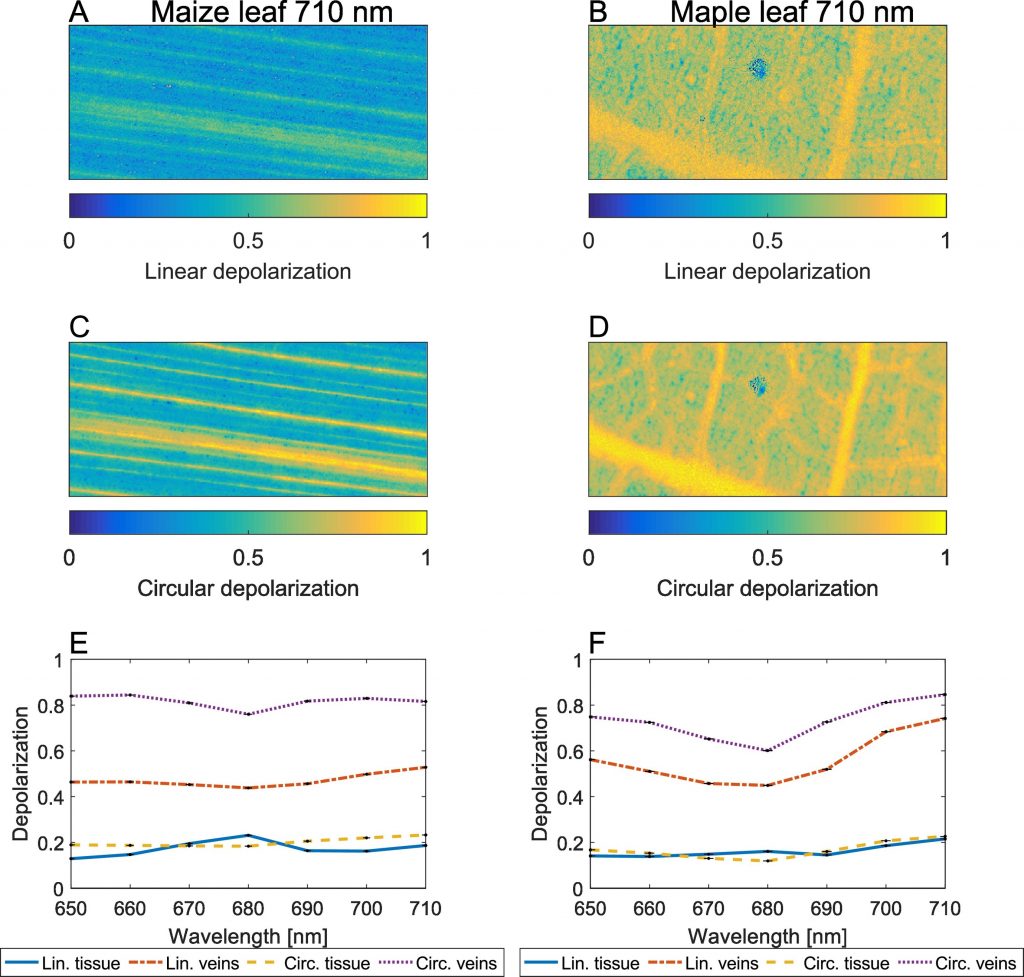
Lucas Patty has yet, after his recent publication in the Journal of Quantitative Spectroscopy & Radiative Transfer (dec 2017), published another paper! The new paper is entitled “Imaging linear and circular polarisation features in leaves with complete Mueller matrix polarimetry”.

Previously they showed that the photosynthetic apparatus in leaves induces circularisation ofunpolarised light due to its isotropic components, in the same amount as that it can absorb circularly polarised light. As these transmission measurements can be executed both in-vivo and post-mortem, they were able to confirmed that healthy leaves can successfully be differentiated from senescing leaves in-vivo.

In the new paper, Lucas shows that not only the photosynthetic apparatus, but also the cell structure and its arrangement within a leaf can create and modify polarisation signals. Basically, both linear  and circular depolarisation is much larger in the veins than in the normal tissue.

Such in-dept understanding of polarisation spectroscopy data can both contribute to agriculture and the remote sensing of life on other planets!


Niclas Nordholt got his PhD

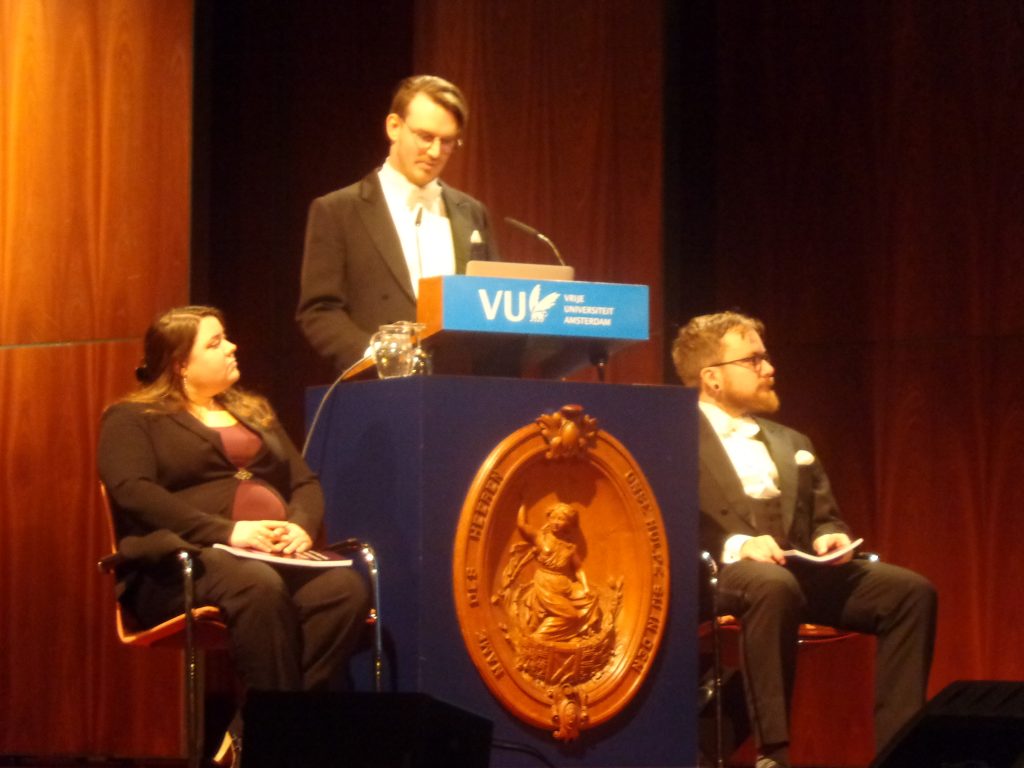
Niclas defended his PhD thesis, titled “Balance on many scales: Growth and gene expression in Bacillus subtilis” on January the 18th 2018. James Locke, Frank Schreiber, Rutger Hermsen, Sander Tans, Leendert Hamoen and Bas Teusink were in the thesis committee. A big thanks to the committee for their efforts, and congrats to you Dr. Niclas!