
The System Bioinformatics section has a new name and from now on will be known as:
Category: Uncategorized
In press: Sebastián’s meticulous comparison of genome-scale metabolic reconstruction tools is published!
A genome-scale metabolic reconstruction is a network of all biochemical reactions that can occur in a cell. These reconstructions have proven to be very useful because they can be used to make phenotypic predictions. Many computational tools to create these reconstructions have been created (or updated) recently, making these genome-scale reconstructions available for everyone. However, a potential user might not know about the best uses of each tool.
We therefore compared these different tools and published our results in Genome Biology. With the help of Brett G. Olivier, Douwe Molenaar and Bas Teusink, seven reconstruction tools were compared with regard to ease of use, compliance with standards and output network quality. For all the tools, some features such as specialist support were evaluated with a high score, while others such as automatic integration of experimental data for automatic network refinement were evaluated with a low score. In most of the cases, strengths in some tools are weaknesses in others. Overall, we show that none of the tools outperforms the other in all the studied features so users should carefully choose one tool or another (or combination of them) depending on the intended use of the model
In particular, the use of the high-quality manually-curated genome-scale models of Lactobacillus plantarum, Bordetella pertussis and Pseudomonas putida as a gold standard, allowed us to evaluate output networks generated with different tools. The research showed that some tools such as AuReMe, MetaDraft of CarveMe generated draft networks which are more similar, in terms of reactions, to manually-curated models than the ones generated with other tools. Other tools such as Pathway tools and Merlin provide a platform with several functionalities for manual curation so it may be adequate for projects where a lot of time can be dedicated to the refinement of the network. ModelSEED (and also CarveME) generates in a few minutes networks which are ready to perform FBA so it may be suitable for large scale screenings. Finally, RAVEN allows integration of multiple databases which may be useful for less characterized species. In any case, the choice will depend on the particularities of the project, so users are invited to check our article to find the perfect fit for their research.
Daan and NWA-Ideeëngenerator
Systeembioinformaticus Daan de Groot met Self-organising adaptation: a universal mechanism for microbial protein expression regulation
Cellen kunnen zich aanpassen aan, en groeien in, een verbluffende hoeveelheid omgevingen. Dit lijkt, gezien de eenvoud van individuele cellen, een onmogelijke prestatie. Maar hoe zit dit als een populatie cellen gaat samenwerken? De onderzoekers stellen een universeel mechanisme voor dat een populatie cellen in staat stelt te overleven, maar waar individuele cellen zouden falen.
Vijf VU-projecten ontvangen uit het NWA-programma (Nationale Wetenschapsagenda) Ideeëngenerator ieder een financiering van 50.000 euro voor de looptijd van één jaar om hun idee verder te onderzoeken.
Chrats published 2 papers
Two papers were recently published by Chrats about microbial communities.
In the first paper, the authors show how microbial communities change during wine fermentations, what are the differences in microbial composition between vineyards and which ones are the species that are present during problematic fermentations. In the second paper, which is a first-authorship for Chrats, the authors applied a computational approach to two microbial communities (from kefir and wine) to find properties that distinguish a species from the others. For example, in the case of Kefir, the algorithm predicted that Lactobacilllus kefiranofaciens was dominant during Kefir fermentations, probably because of the high amount of amino acid auxotrophies.
Overall, both papers provide new bioinformatics tools to study very complex microbial communities and generate new insights for important fermentations in the food industry.
Paul published a review
JBAH-Vol.9 No.10 2019.pdf
Journal of Biology, Agriculture and Healthcare www.iiste.org
Vol.9, No.10, 2019
From Functional Potential of Soil Bacterial Communities Towards Petroleum Hydrocarbons Bioremediation
Abstract
Molecular ecology researches are rapidly advancing the knowledge of microorganisms associated with petroleum hydrocarbon degradation, one of the major large-scale pollutants in terrestrial ecosystems. The design and monitoring of bioremediation techniques for hydrocarbons rely on a thorough understanding of the diversity of enzymes involved in the processes of hydrocarbon degradation and the microbes that harbor their allocated genes. This review describes the impact of hydrocarbon pollution on soil microbial communities, the state of the art of detecting functional genes, and functional groups. We will focus on i) the structure, function and succession behavior of microbial communities exposed to hydrocarbons, ii) key genes and pathways, iii) future prospect into bioremediation of petroleum hydrocarbons in aerobic environments. The aim is to get a fundamental insight in these issues to ultimately improve petroleum hydrocarbons bioremediation.
Coco and Rinke presented at NWO-Life 2019
We were represented well at the first edition of the multidisciplinary congress for life scientists: NWO Life 2019.
Coco presented the three different methods that she developed to measure bacterial responses to antibiotics. Checkerboards, fermentors and droplets: Coco uses all of them to distinguish who invades, who resides, and who persists. Given that similar bacteria can invade, reside or persist in our own bodies, there is little need to explain the relevance of this work.
Rinke also uses droplets, but for a different question: can cells communicate? And if so, can they send specific messages to close-by cells, or are their messages open for everyone? She showed that cells can only communicate privately if they live really close together (literally glued to one another). Although this seems abstract at first, it has important consequences for the evolution of symbiotic species: several bacteria that work together to grow faster (which is for example important in yoghurt production). Rinke expects that partnerships can only arise if cheaters are excluded. Conclusion: the partners should have evolved really close together. We all hope that future experiments will tell if this prediction is correct.
Besides our own delegation, there were many enthusiastic speakers. Most impressive were probably the keynote speakers: Iain Couzin and Ottoline Leyser. They talked with so much conviction that it didn’t matter that their research fields were quite far away from microbiology.
Daan, European Champignon Duathlon 2019
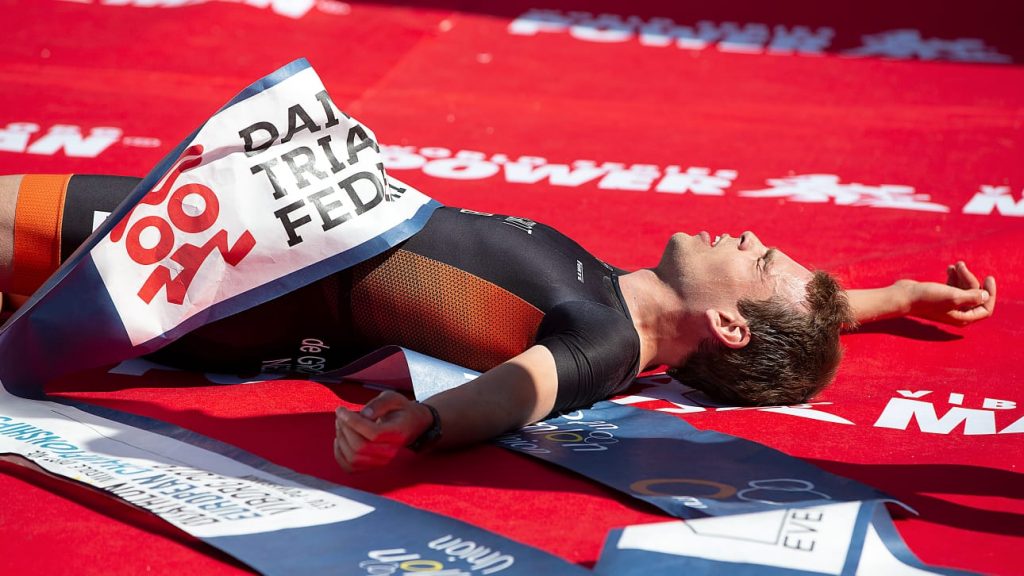
Daan de Groot
European Champignon Duathlon 2019
Powerman Middle Distance, Elite Men
Viborg – Nytorv, Denmark • 11 May, 2019

In press: Rate maximisation makes the most complex microbes behave simple!
Our theoretical work on rate maximisation in metabolism has been published in Plos Computational Biology. In this work, we took a very general approach to ask a very specific question: we included genome-scale metabolic networks, complicated enzyme kinetics, and arbitrary constraints on enzyme expression, and then asked what metabolism looks like for a microorganism that maximises its biomass production. The answer: it looks quite simple. Only a few independent pathways are used by the microbe, giving rise to the linear relations and growth laws that are found across microbiology. With this result, we can not only model important phenomena such as overflow metabolism and co-consumption, but we can even understand them.
Over the past years, we have worked on this project a lot and we are very proud of the result. Daan: “Personally, I got the best introduction to academics and systems biology that I could have hoped for: from mathematical optimisation approaches (taught by Bob), doing lab work and coping with the corresponding disappointments (taught by Coco), to thinking, theorizing, writing and picking colours for your figures (taught by Bas and Frank).” We hope that our general, theoretical approach, will lead to more results and a better overall understanding in the near future.
The full open access article can be found here: https://doi.org/10.1371/journal.pcbi.1006858
In press: Dennis’ extensive characterisation of Fluorescent protein behaviour in yeast is published!
Dennis’ work on the
You can find the open access article here.
Ever thought about the semantic annotation of computational models?
Some of us in the COMBINE community did and this paper is the result:
Harmonizing semantic annotations for computational models in biology – Briefings in Bioinformatics – 21 November 2018.
Recent Comments