Lab retreat 2017 was a great success

We all moved for three days to Groesbeek for our yearly lab retreat, this year organised by three new PhD students, Eunice, Daan and Sieze. They did a wonderful job: many people introduced a problem in the morning, from technical (how to model complex communities) to more evolutionary (why do lactic acid bacteria make flavours?), which led to group discussions, model making and literature search – which was slightly compromised by shitty wifi, but G4 worked wonderfully too. In the evening or morning the results were presented, and we can conclude that many issues are not solved yet (some were!), but alliances have been formed in the group to solve them back in Amsterdam. And we learned a lot!

Here is Frank discussing with Johan and Daan, … and beer. Meanwhile, other were preparing food – no thinking without enough energy.

here Esther, Bas and Eunice organise the dinner: we had chilli one day, spinach lasagna the other day. Always fun to cook for 20 in a kitchen without sharp knives…

and of course, getting to know each other in different ways. “Cow trade” is a wonderful card game that requires bluff, wit and a bit of luck. Paul fooled all of us by playing ignorance of the game, and buying in too high, but in the end he took us to the cleaners.

Finally, Jurgen organised a pub quiz, with impossible questions about long forgotten music, but since he was making most of the pictures, we have no picture. Sorry Jurgen, but thanks for a wonderful evening, and everybody else for a great retreat!


paper by Johan got three stars recommendation at F1000

Herbert Sauro, systems and synthetic biologist from University of Washington, Seattle, recommended the 2015 BioEssays review that Johan wrote together with Frank and Bas, saying it is an essential read for biochemistry textbook writers. The review is about the regulation of glycolysis, explained from a functional supply-demand perspective. See Access the recommendation on F1000Prime for the recommendation text.
Thanks for the warm words Herbert!

Another theorist went to the wet/dark side

Another theorist has been spotted in the lab yesterday. Daan de Groot, in the picture trying to pipet water into a tube with the cap still on, will try to validate a theoretical prediction.

Coco van Boxtel, everybody’s favorite red-haired lab worker, will guide him through the process, thereby ensuring upcoming successes. The first success has already been spotted: E. coli seems to thrive on the medium that was made.

Iraes Rabbers wins the AIMMS PhD competition

On the 13th of April, our institute, the Amsterdam Institute for Molecules, Medicines and Systems (AIMMS), organised its annual symposium with a PhD student contest for best talk of the day. Iraes Rabbers presented her thesis work on the optimality of protein expression in E coli, and won! Congrats Iraes, well done!

Our master in Bioinformatics and Systems Biology is TOP!

In the latest results from the National Student Enquete (Inquiry) NSE our master got an 8.2 out of 10, and this makes it officially a TOP master, one of only 6 TOP masters at the VU. The master is a joined effort of Systems Bioinformatics and Bioinformatics from the VU, and the Life Science groups from the University of Amsterdam. For more information about the TOP master, go here.

First recommendation for F1000 published

Bas was asked to contribute recommendations to the Faculty of 1000, and group members can nominate papers, and help write the recommendation – and get the credits. This month’s recommendation can be seen here.

Article details:
Dynamic control of gene regulatory logic by seemingly redundant transcription factors.
Z AkhavanAghdam, J Sinha, OP Tabbaa and N Hao
elife 2016 Sep 30; 5
DOI: 10.7554/eLife.18458

When the yeast genome was first sequenced in 1996, scientists were puzzled by the seeming redundancy of genes; in fact, the whole genome of Saccharomyces cerevisiae was duplicated during its evolution. Many – not necessarily conflicting – explanations were provided, such as enhancing flux {1}, acting (or not) as backup systems {2}, or leading to differential sensitivity to external cues {3}. This paper by the Hao lab extends work done in the O’Shea lab {4,5} on the dynamics of Msn2/Msn4-mediated transcriptional regulation to provide another functionality – to act as dynamic logical gates. From the paper: “Either Msn2 or Msn4 alone is sufficient to induce the expression of target genes with fast kinetics promoters, constituting what is essentially a biological ‘OR’ logic gate. In contrast, the induction of target genes with slow kinetics promoters requires activation of both factors, forming an ‘AND’ gate.” The work emphasizes the role of time scales in regulation logic, and adds a beautiful example to the collection of functional network motifs {6}.

I would like to thank Dr Johan van Heerden for assistance in the preparation of this recommendation.

References:
{1} Increased glycolytic flux as an outcome of whole-genome duplication in yeast. Conant GC, Wolfe KH. Mol Syst Biol. 2007; 3:129 PMID: 17667951 DOI: 10.1038/msb4100170
{2} The cellular robustness by genetic redundancy in budding yeast. Li J, Yuan Z, Zhang Z.
PLoS Genet. 2010 Nov; 6(11):e1001187 PMID: 21079672 DOI: 10.1371/journal.pgen.1001187
{3} The competitive advantage of a dual-transporter system. Levy S, Kafri M, Carmi M, Barkai N. Science. 2011 Dec 9; 334(6061):1408-12 PMID: 22158820 DOI: 10.1126/science.1207154
{4} Tunable signal processing through modular control of transcription factor translocation. Hao N, Budnik BA, Gunawardena J, O’Shea EK. Science. 2013 Jan 25; 339(6118):460-4 PMID: 23349292 DOI: 10.1126/science.1227299
{5} Signal-dependent dynamics of transcription factor translocation controls gene expression. Hao N, O’Shea EK. Nat Struct Mol Biol. 2011 Dec 18; 19(1):31-9 PMID: 22179789 DOI: 10.1038/nsmb.2192
{6} Network motifs in the transcriptional regulation network of Escherichia coli. Shen-Orr SS, Milo R, Mangan S, Alon U. Nat Genet. 2002 May; 31(1):64-8 PMID: 11967538 DOI: 10.1038/ng881


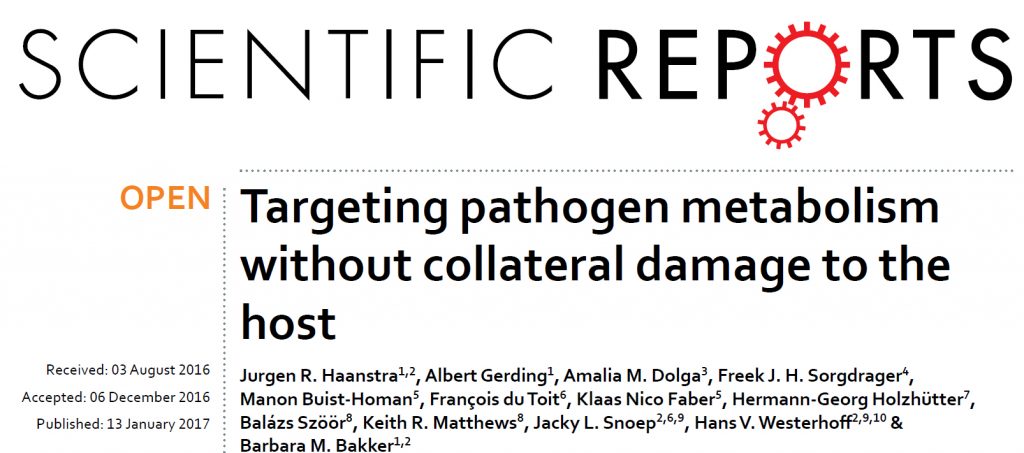
Jurgen published a new paper on Network-based drug design in Scientific Reports

Screenshot_paper_Haanstra

Jurgen published a paper from his postdoc in the labs of Prof. Barbara Bakker (UMCG) and Hans Westerhoff (Molecular Cell Physiology, AIMMS, VU)

What it is about:

To avoid side-effects of drug treatment to healthy cells, drug target selection studies often focus on protein targets that are only found a disease-causing cell. However, many disease-causing cells, like parasites and cancer cells, are biochemically very similar to their host and therefore the number of proteins unique to such cells are scarce.

Nevertheless, due to subtle, quantitative differences between the biochemical reaction networks of disease-causing cell and healthy host cells, a drug can affect the same essential process in one cell-type more than in another. This papers shows a proof-of-principle how quantitative differences in cellular networks can be exploited to selectively hit the disease-causing cells.

In this paper, the authors combined computational and experimental approaches to compare energy metabolism in the causative agent of deadly sleeping sickness, Trypanosoma brucei, with that of human erythrocytes. The computational analysis revealed that inhibitors of the uptake of glucose would affect energy metabolism in T. brucei stronger than in erythrocytes. Computational predictions were validated experimentally in a novel parasite-erythrocytes co-culture system. They  furthermore showed that glucose-transport inhibitors killed trypanosomes without killing neurons or liver cells.

This study shows that very promising and selective drug targets can exist outside the realm of the unique proteins and thereby extends the pool of putative, selective drug targets. The important next step is to translate this knowledge to actual drugs: to design and synthesise drug-like molecules that inhibit the glucose transporter of T. brucei and stay active inside the human body. Furthermore, this network-based approach to drug target selection can also be applied to other diseases like cancer and diabetes.

Waar het over gaat:

Diverse ziekten worden veroorzaakt door snel delende ziekteverwekkers in ons lichaam. Voorbeelden zijn infecties met bacteriën en parasieten, maar bijvoorbeeld ook kanker. Bij de zoektocht naar nieuwe medicijnen moeten we er voor zorgen dat de gezonde cellen van de mens niet geraakt worden. Dit is erg lastig naar mate de ziekteverwekker veel overeenkomsten vertoont met de mens.

Er is met een nieuwe methode gezocht naar verschillen tussen een dodelijke parasiet (Trypanosoma brucei die slaapziekte veroorzaakt) en zijn menselijke gastheer en die ook gevonden. Zowel de parasiet als cellen de mens moeten allebei suiker afbreken in een aantal opeenvolgende stappen om er energie uit te halen om in leven te blijven. Hiervoor gebruiken beiden een vrijwel identiek ’machinepark’. Vanwege deze gelijkenis zal een medicijn die een van de machines minder hard laat werken niet alleen deze machines van de parasiet raken maar ook die in de cellen van de mens. Echter, de beide machineparken hebben dan misschien wel dezelfde machines, maar elk van de twee heeft net een andere hoeveelheid machines die nodig zijn voor specifieke onderdelen van de suikerafbraak en ze misschien wel iets aangepast om ze harder te laten werken. Hierdoor zijn er mogelijk andere zwakke plekken in het machinepark van de parasiet dan in dat van de mens

Met bovenstaande in gedachten, is de suikerafbraak in parasiet en bloedcellen van de mens met elkaar vergeleken met behulp van computermodellen die de werking van beide ‘machineparken’ goed kunnen simuleren. Hieruit bleek dat er inderdaad belangrijke verschillen zijn: als men in de computer de machine die de opname van suiker regelt minder hard laat werken bleek dat de parasiet ineens veel langzamer energie ging maken, terwijl dit nauwelijks effect had voor de snelheid van de energieproductie in de menselijke bloedcellen. Een medicijn die de suikeropname verlaagt zou dus alleen de parasiet zonder energie laten zitten en dus weinig bijeffecten geven. Inderdaad, als parasieten en menselijke bloedcellen in het lab bij elkaar worden gestopt en een chemische stof geven die de suikeropname remt lukt het om alleen de parasieten te doden.

Dit werk laat zien dat we op deze manier goedwerkende en veilige doelwitten voor medicijnen tegen ziekteverwekkers kunnen vinden. De volgende stap is om nu echte medicijnen te maken die parasieten op deze manier in het menselijk lichaam kunnen doden. Deze methode is ook toepasbaar op andere ziektes, zoals kanker.

Mathematicians in the wetlab!

planque_et_al-in-het-lab

More and more ‘dry’ scientists are going into the wetlab. Today, Rinke showed students and Bob (on the right) around in our wetlab as part of the Workshop Mathematical Modelling (a third year course for VU and UvA Mathematics students). Will this be a one-time event or do they now never want to leave the wetlab…?